As an engineer with nearly 30 years of experience in CAD/CAM software R&D, I am frequently consulted by industry experts, enterprise customers, and investors about the particular challenges of domestic 3D offline programming CAM software development. Why do many domestic CAM products look impressive in promotional materials but are rarely seen in actual frontline production?
First, let me explain what CAM software is. According to CIMDATA's definition, CAM software falls under the PLM (Product Lifecycle Management) category within CAx software tools. CAD (Computer Aided Design) is the foundation and platform of CAx software, while CAE (Computer Aided Engineering) handles engineering design calculations. Offline programming, commonly called OLP, belongs to CAM (Computer Aided Manufacturing).
CAM software has a manufacturing 'M' — it is software for manufacturing, and manufactured products come in countless varieties, each requiring different manufacturing processes. Because of these different processes, CAM software must have corresponding process packages. These packages are not imagined by developers in offices but are converted from actual customer application processes. Each customer has unique characteristics, and CAM software must extract commonalities from various approaches, then iteratively refine them through repeated use at customer sites to form standardized products.
Therefore, multiple mature process packages represent the first challenge in CAM software development. Each package comes from production frontline experience and requires many customers using the same process and extensive parts machining to iterate. A single process package needs at least one year from R&D through project implementation to maturity, and a dozen relatively mature process packages cannot be developed without approximately 10 years of iteration. In the industry, CAM software providing over 10 process packages is considered very mature.
Why can many domestic products only be used for project applications, animations, or educational training? Because these products have no enterprise customer usage — they haven't developed process packages through actual production demands or only provide very rough packages without detailed processing. Customers immediately recognize that such software has never been used in actual workshop machining and naturally won't purchase it.
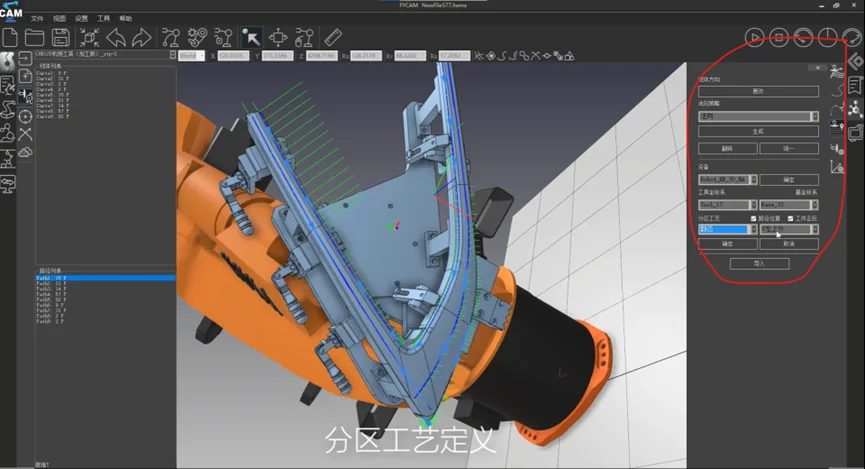
HedraCAM OLP Offline Programming Software — with its complex polishing process package
The second challenge is detail handling. Many software solutions, including some foreign ones, require customers to purchase CAM software plus additional hardware such as 3D vision systems, constant-force grinding heads, and measurement equipment. Equipment limitations are also numerous — for example, robot programming software that can only output post-processor programs for a few robot brands. This completely reverses priorities and only indicates that such software only considers basic trajectory planning without addressing many machining details. For customers seeking to improve efficiency and reduce costs through digital transformation, choosing CAM software with thorough detail consideration, comprehensive post-processing, and professional process packages — while improving on existing processes without adding hardware costs — achieves the lowest cost with results that are not necessarily inferior.
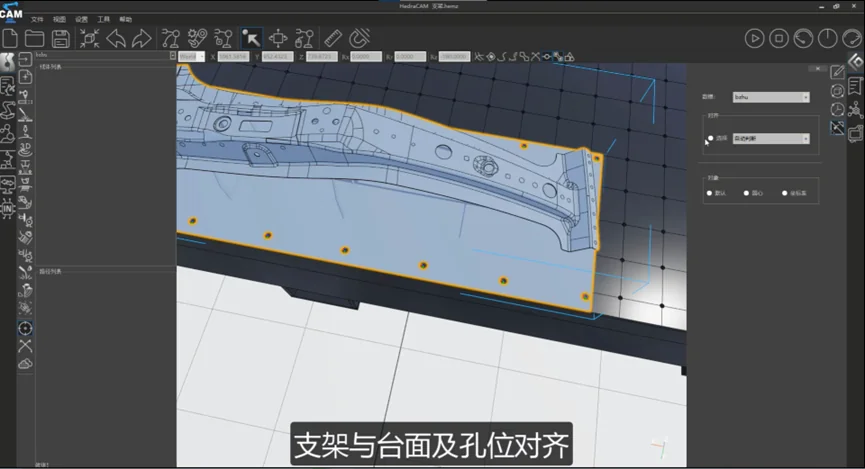
HedraCAM Pentacut 5-Axis Programming Software — solving rapid workpiece positioning through software processes
The third challenge is usability — a perennial topic. Ease of learning and use is the ultimate goal of every industrial software product. From the user's perspective, most people currently using CAM offline programming software domestically are workshop frontline technicians or even general workers. Enterprises demand maximum simplification. Many foreign software products, particularly European ones, are not well-suited to current domestic workforce conditions, and domestic software imitating European products considers usability even less. Many developers believe that meeting functional requirements is sufficient — this development mindset must be firmly rejected.
As a side note, CAM offline programming technology has been rapidly iterating in recent years, gradually evolving into automatic task programming software. Some innovative CAM software has already achieved fully autonomous trajectory planning for less complex processes, and some have even achieved process generalization. Looking forward, these will inevitably replace traditional CAM offline programming software.
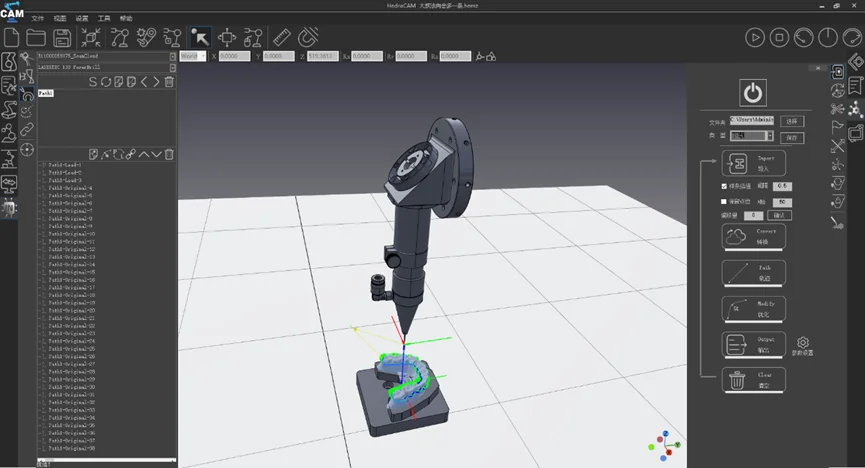
HedraCAM AI In Task Programming Software — achieving autonomous intelligent programming
Finally, an easily overlooked issue: in recent years, many domestic CAM products have appeared that are secondary developments based on third-party platforms, significantly shortening development cycles and seemingly easier to produce results. However, this approach is like building your own house on someone else's foundation — it is essentially a major trap that will fail in both business model and technology. Looking at all successful commercial CAM software worldwide, without exception, they have their own independent architectures and self-developed CAD technology.
I also advise enterprise customers to carefully select CAM software based on secondary development of third-party CAD platforms. Such software has clear technical disadvantages in system compatibility and stability, feature upgrade iteration, and usability. Because they must bear third-party CAD licensing fees and upgrade costs, customer usage costs are high and the business model is unsustainable. In fact, all conceivable paths were explored by foreign companies decades ago. The author personally encountered multiple foreign software companies using this model in earlier years — they all eventually went bankrupt, causing losses for their customers.
In summary: CAM software is a critical workshop-level tool for manufacturing. Developing a mature commercial product requires extensive enterprise application iteration — there are absolutely no technical shortcuts. Domestic CAM software must endure long-term dedication (approximately 10 years of R&D for enterprise markets) and start from the most fundamental research to have any hope of success.