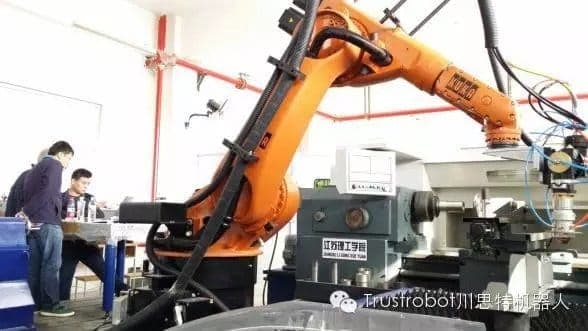
In November 2014, our company provided offline programming training and guidance for the KUKA robot system at Changzhou Jiangsu Institute of Technology (hereinafter referred to as "Jiangsu Tech") using HedraCAM software. HedraCAM supports the full range of KUKA robots and supports slide rails and positioners, making it especially suitable for beveling and complex pipe laser processing. This collaboration involved Jiangsu Tech's materials research laboratory, which, in support of research and teaching, purchased a KUKA KR 60 HA six-axis robot equipped with a laser cutting tool head, a laser cladding tool head, and a laser welding tool head to achieve versatile multi-tool applications on a single machine.
On site, the KUKA six-axis robot was placed on a slide rail (external E2 axis) and equipped with a rotary positioner (external E1 axis), bringing the total number of associated axes to eight. Traditional manual calibration can no longer meet the needs, and multi-axis coordinated control is precisely the strength of our HedraCAM. Without the tedious manual calibration, users can easily obtain satisfactory complex contour processing programs by clicking the mouse on a computer with computer-aided assistance. In traditional robot programming, sampling points along the processing path manually is time-consuming and imprecise.
Debugging personnel often spend a great deal of time and energy on repetitive mechanical calibration steps — it often takes three to four hours just to roughly sketch out a three-dimensional contour outline. Moreover, the quality of the cut workpiece cannot be guaranteed. Most importantly, for workpieces with cutting curves covering the entire cylindrical surface, secondary clamping is required, resulting in even worse processing efficiency and consistency. When using HedraCAM for auxiliary programming, users only need to input the digital model of the workpiece to be processed and use the software to select the contours to be processed, and the trajectory path can be quickly generated.