China's booming robot industry is like a gold mine, with gold diggers coming in crowds. Trustrobot does not dig for gold itself — instead, it paves the way for these gold diggers, providing them with the most practical and actionable solutions.
North of Nanjing's main city, traveling along Yaoxin Road, you arrive at the Xitian New Port Development Zone. Trustrobot Software Technology Co., Ltd. is located in the zone, surrounded by green trees, quiet and orderly. General Manager Jin Zili told us that they had moved here less than two weeks ago, and the core laboratory and a robot intelligent manufacturing equipment workshop had not yet been set up.
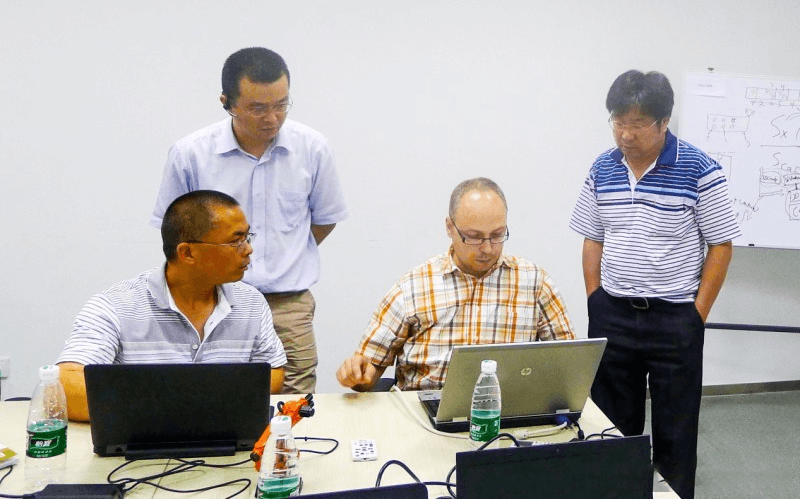
Jin Zili is one of the founders of Trustrobot Software. He has three other partners, from the UK, USA, and Germany respectively. Each of the four is responsible for a different area of the business. Jin Zili focuses on marketing and promotion. Transitioning from a pure tech geek to the company's marketing head has been a natural progression over more than a decade of entrepreneurship, riding the wave of China's entire manufacturing industry development trend.
Looking at the robot industry chain — core component manufacturing, robot body manufacturing, system integration, and industry applications — as Jin Zili puts it, Trustrobot's role is that of a "bridge builder," sitting in the system integration segment. Their slogan is: "Making robot manufacturing simpler!"
Specifically, they are a high-tech enterprise with advanced manufacturing technology and industrial robot automation industry and robot intelligent manufacturing system development, technical service outsourcing, and system integration as main businesses. Currently, they are the only company in China providing independently developed robot production line virtual simulation and offline programming software solutions.
Before entrepreneurship, Jin Zili worked as a programmer in the mold department of a multinational company in Guangdong. He was a typical tech geek. His main work involved programming machine tool processing, and on a daily basis, he was responsible for testing the most cutting-edge CAM software in the CNC machine tool field internationally. In 2000, he switched to selling CAM software at a company in Nanjing. In 2002, he started his own business in Shanghai, initially as an agent for foreign CAD/CAM software.
In 2005, he met his partner Bo Tao in the UK — a British Chinese who graduated from Loughborough University's Computer Science department. The two hit it off immediately. They then used a UK software platform to develop a multi-axis laser cutting module, successively undertaking many CAM software customization development tasks for famous machine tool companies in Germany, Japan, and Italy.
During this process, Jin Zili and his entrepreneurial partners earned their first bucket of gold. However, through cooperation with foreign software companies, they also felt the unfair treatment Chinese people face in the CAD/CAM/CAE industry — having no independent software brand or core technology, and no voice in the industry. CAD/CAM/CAE software sold by developed Western countries to China was priced much higher than in developed countries. Whenever encountering such situations, Jin Zili always felt a sense of powerlessness, secretly believing that only by mastering core technology could one stand tall in the industry with confidence.
In 2009, they undertook the task of developing a laser programming CAM for French company Staubli's robots, entering the robot industry. They then registered Trustrobot Software in Nanjing. Trustrobot is a homophone of the English word "Trust." After several years of market trials and tribulations, transitioning from unfamiliarity with the robot industry to gradually becoming industry experts. After extensive research, they discovered the gap China would face in smart manufacturing software. With the addition of architect David Guo and senior development manager Luk Ke, they began developing a new generation of robot smart factory virtual simulation software HedraSMF and robot offline programming software HedraCAM.
HedraSMF and HedraCAM software are primarily used for virtual simulation and offline programming of robot automated production lines in factories. Jin Zili told us that industrial software R&D is completely different from internet app R&D. Industrial software must be precise and flawless — even a small error could cause the entire production line to crash, and no enterprise could afford such losses.
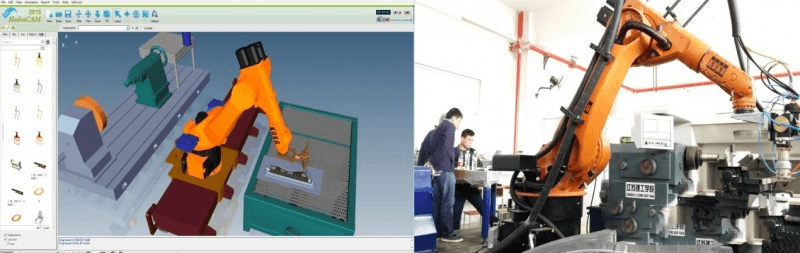
HedraCAM uses 3D virtual simulation to determine the dynamic change process of the robot body and its working environment. This allows enterprises to simulate physical objects before manufacturing units and production lines are built, shortening production timelines and avoiding unnecessary rework. During production line implementation, programs direct the robot's movements. This product can greatly reduce enterprise production costs and significantly improve production efficiency.
Including their prior R&D time in the machine tool field, Jin Zili and his team have quietly worked in the industrial software field for over a dozen years. Domestically, they occupy a market unoccupied territory.
It is understood that currently, there are no fewer than 5,000 companies engaged in robot-related businesses in China, but most have weak independent brands, lagging core component R&D, low product recognition and added value, completely dependent on others, and lack core technology R&D capabilities. Compared to this, foreign robot industries have developed quite maturely. Having been tested by the market, a few giants have formed a monopolistic situation. China's robot industry is just beginning, with numerous contenders battling for supremacy.
Trustrobot does not participate in robot body manufacturing or robot integration, cleverly avoiding the white-hot competitive manufacturing market, and winning through "soft" solutions. As Jin Zili describes it: China's booming robot industry is like a gold mine, with gold diggers arriving in crowds. Trustrobot does not dig for gold itself — it paves the way for these gold diggers, providing them with the most practical software solutions.
Trustrobot has gradually gained recognition in the industry. Although the brand was formally established only a few years ago, they have established long-term cooperative relationships with more than a dozen large domestic enterprises and institutions.
Jin Zili explained that because they have their own core technology, for some customers, when the use results are consistent, choosing Trustrobot's products is preferable to using foreign companies' products. A few years ago, they cooperated with AVIC Beijing Manufacturing Technology Research Institute to develop a dedicated laser cutting offline programming software. This software is more intuitive, flexible, and easy to use, and has played a significant role in defense industry engine and wing manufacturing.
In November 2014, they provided HedraCAM software offline programming training and guidance for a KUKA robot system at Jiangsu University of Science and Technology in Changzhou. HedraCAM supports the full range of KUKA robots, including slides and positioners, and is especially suitable for bevel and complex pipe laser processing. The cooperating party was Jiangsu University of Science and Technology's Materials Research Laboratory. To support research and teaching, the laboratory purchased a KUKA KR60 HA six-joint robot, equipped with laser cutting, laser cladding, and laser welding tool heads, achieving one machine with multiple tools for wide-ranging applications.
Jiangsu University of Science and Technology faculty praised HedraCAM highly. The software combines perfectly with the KUKA robot system, greatly simplifying the learning and operation steps for faculty and students in teaching research and practice, making the learning process for robot application beginners truly simple and easy.
This year, they began cooperating with many institutions engaged in robot education, cultivating large numbers of useful talents for the country in both higher and vocational education. Several well-known universities including Southeast University have designated HedraSMF software as the professional course and training software for newly established robot undergraduate teaching courses.
With the vigorous development of China's robot industry, Trustrobot, as a "bridge builder," will also rise with the tide, ushering in a broad and promising market. Jin Zili introduced that with the continuous rise in labor costs, market demand for industrial robots will become increasingly strong.
For a simple example: an injection molding machine equipped with two workers, based on current human resource costs, each worker's monthly cost is at least 5,000 to 6,000 RMB. Theoretically, two workers work 24 hours in two shifts, without rest, never getting sick or taking leave. If a workshop has 20 people, then monthly labor costs are at least 1 to 1.2 million RMB. However, if robots are used, one robot can attend to two machines, equivalent to four workers, without needing rest, working 24 hours. Additionally, the cost of robot investment is also decreasing. Ten years ago, an industrial robot might cost 300,000 RMB; now it is only about 100,000+. This calculation shows that large-scale robot adoption by manufacturing enterprises is an inevitable trend, and China will become the world's largest robot market.
In fact, some robot experts in the industry generally believe that robot development will be the beginning of the Third Industrial Revolution. Experts also propose the next key problem the robot industry urgently needs to solve: "human-robot collaboration" — workers and robots working together in the same workshop. Humans do more creative work with robot assistance, while robots perform high-precision, repetitive work.
Trustrobot Software, by settling down and dedicating more than a decade to independent technology R&D, can occupy the commanding heights of the industry when China's robot industry takes off, waiting quietly for the market to bloom. Looking at the current situation, the vast majority of companies in China's robot industry are constrained by weak independent R&D capabilities. Although the robot industry is a sunrise industry, any enterprise that wants to go further, more stably and durably, faces a real test.