As manufacturing industry develops and transforms, an increasing number of enterprises are beginning to focus on smart manufacturing and digital factory construction. To better achieve advanced manufacturing, enterprises need to adopt advanced technologies and software solutions to meet growing market demands and tight delivery schedules. A successful smart manufacturing system requires advanced equipment as well as efficient, precise intelligent programming technology.
Kunshan Kaixin Precision Machinery Co., Ltd. (Stock Code: 838241) is a high-tech joint-stock enterprise specializing in shot peening reinforcement/shot peen forming and surface treatment process development, as well as machine tool R&D and manufacturing. Its products are widely applied in aviation, aerospace, shipbuilding, steam turbines, locomotives, automobiles, diesel engines, wind power, metallurgy, and other fields. Based on its own equipment, processes, and actual customer needs, the company proposed an automation, digitalization, and intelligent development strategy for impact reinforcement shot peening equipment, and collaborated with partner Nanjing Trustrobot Software to fully develop an intelligent low/unmanned robot shot peening system. Recently, a key breakthrough was achieved — the robot intelligent blade shot peening machine was officially put into mass production. Impact reinforcement is the final process in blade machining. Its function is to use high-speed moving shot streams impacting the metal surface to create plastic cyclic strain layers on the blades, thereby causing favorable microstructural changes in these layers and introducing residual compressive stress fields. The surface microstructure and residual compressive stress fields are two key strengthening factors that improve the fatigue fracture and stress corrosion (including hydrogen embrittlement) fracture resistance of metal parts, ultimately enhancing blade reliability and durability.
Before adopting the automatic shot peening system, Kaixin Precision mainly used HedraCAM's specialized shot peening offline programming software for robot trajectory planning and simulation. This method required customer CAD models, with programming taking approximately ten minutes per part — well-suited for high-volume production with accurate CAD models matching actual parts. However, market and customer needs have changed dramatically. Blades, especially large steam turbine blades, are mostly single-piece production. Using offline programming software to program each part individually would be inefficient and unable to meet customer demands for "lights-out factory" unmanned automated production cycle requirements.
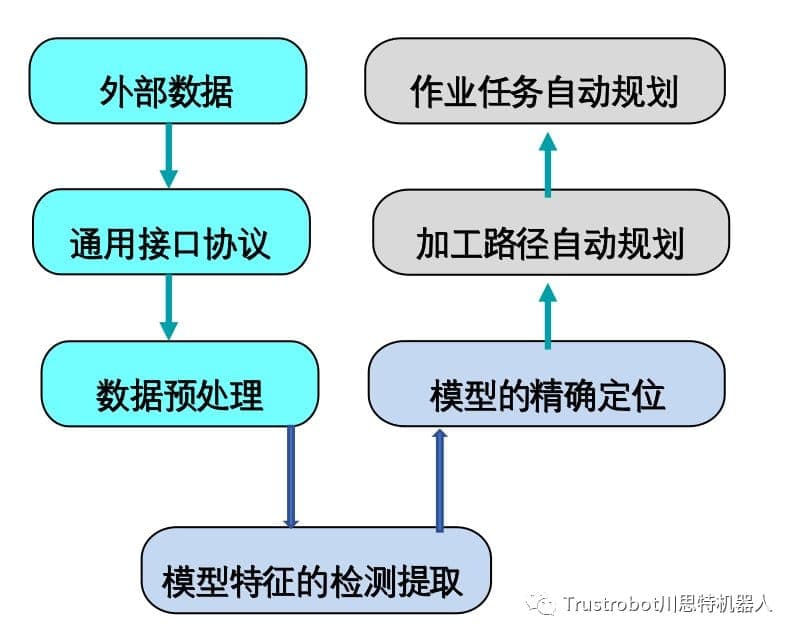
Through years of R&D, Trustrobot developed an AI intelligent programming simulation solution — HedraCAM Inside — using the combination approach of "front-end external data rapid processing + back-end reinforcement learning robot posture automatic generation," based on the HedraCAM simulation kernel. This achieves unmanned intervention-free generation of robot teachless 3D operation programs. Targeting Kaixin Precision's actual needs, Trustrobot adopted the intelligent programming solution to replace the original offline programming approach. The solution consists of a non-contact 3D line laser scanning system and HedraCAM AI Inside software, specifically designed for 3D complex trajectory surface feature programming, without restrictions on robot types. This method mainly targets small-batch multi-variety manufacturing modes and can quickly establish robot trajectories for curved surface machining, achieving programming without human intervention.
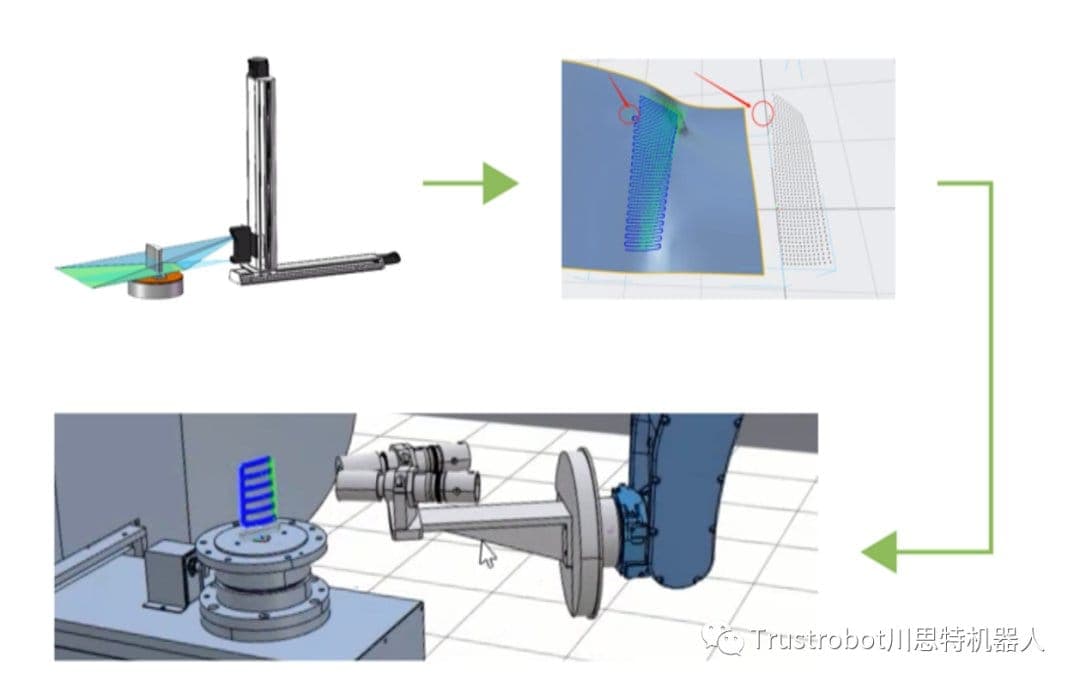
Specific steps are as follows: Step 1 — Front-end external data: Obtain blade scanning point cloud files through 3D vision scanning equipment; Step 2 — Rapid data processing and positioning: Through classification processing of scanned data, rapid identification, extraction, and matching of workpiece machining features closely related to actual shot peening processes (common geometric features such as points, lines, surfaces, and bodies), achieving blade marking and precise positioning; Step 3 — AI intelligent processing: Automatic planning of machining paths mainly considers automated generation of machining trajectory points, minimizing robot posture changes, over-limit and ambiguous positions, obstacle avoidance, external axes, and other factors. AI reinforcement learning finds the optimal robot and external axis postures, and automatic obstacle avoidance training is conducted in the simulation environment; Step 4 — Back-end communication: Post-processing considering machining process parameter settings, plus digital twin technology for interconnection and intercommunication with the robot controller, outputs machining programs to the robot end for automated machining.
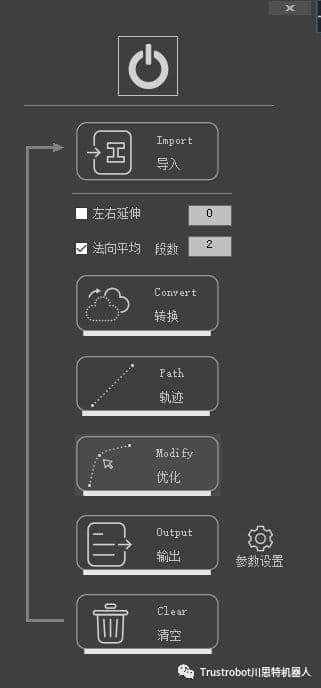
The entire software system runs automatically without human intervention. Technical personnel simply press a Start button to automatically complete all tasks. After the system finishes processing one part, it automatically cycles to process the next... The successful implementation of this automated unmanned AI programming project has achieved remarkable results across multiple aspects. The original manual shot peening or offline programming blade preparation time was as high as 3-6 hours. Now, including machining time, it takes less than half an hour to process one part, and it can achieve 24-hour uninterrupted "lights-out factory" cyclic production. Enterprise production efficiency has greatly improved.