Many customers visiting our company often ask why we have two software products: HedraCAM offline programming and HedraSMF production line simulation. What is the difference between offline programming and production line simulation software? According to internationally accepted definitions, this field belongs to PLM (Product Lifecycle Management). CAX product innovation tool software includes CAD\CAM\CAE.
CAD (Computer Aided Design) is the foundation and platform of CAX software. In industrial robotics, CAD software is typically used for 3D modeling and mechanical design. For example, robotbody models and production line 3D models are all created by engineers using CAD software. Offline programming belongs to CAM (Computer Aided Manufacturing), while production line simulation belongs to CAE (Computer Aided Engineering).
Robots need trajectory planning for processing. Generally, simple processing trajectories can be completed using the robot's own teach pendant. For complex 3D trajectory points that cannot be completed manually, CAM offline programming software is needed. CAM software calls the part's 3D CAD model for trajectory planning, then uses the simulation module to virtually verify the generated trajectory points, checking for collisions, joint compliance and other rationality issues. Problems are adjusted through software tools, and after verification is complete, the trajectory points and process points are simultaneously output to the robot for processing through the specified brand's robot post-processor.
Due to different processes, CAM software is highly specialized by industry. Milling/grinding/polishing/cutting/plate welding/intersecting line welding/3D printing and other processing methods have completely different processes and trajectory generation methods. This is why there are so many CAM software products on the market, and no single software can cover everything. Abroad, many companies have just a few people who are familiar with aspecific industry, find a suitable CAD platform, slowly accumulate experience, and develop a good CAM software.
For example, our HedraCAM software is designed for robot offline programming in laser cutting, intersecting line welding, cladding and 3D printing industries. Because we have been in laser processing for over 20 years, we have deep technical accumulation and background in this industry. Offline programming mainly uses technologies such as mesh topology, geometric algorithms, path planning, and motion control. Most offline programming software issecondary development based on other brands' 3D CAD software, with many limitations. Customers generally need to pay for both CAD+CAM licenses. HedraCAM has its own CAD topology kernel, giving it advantages in future development.
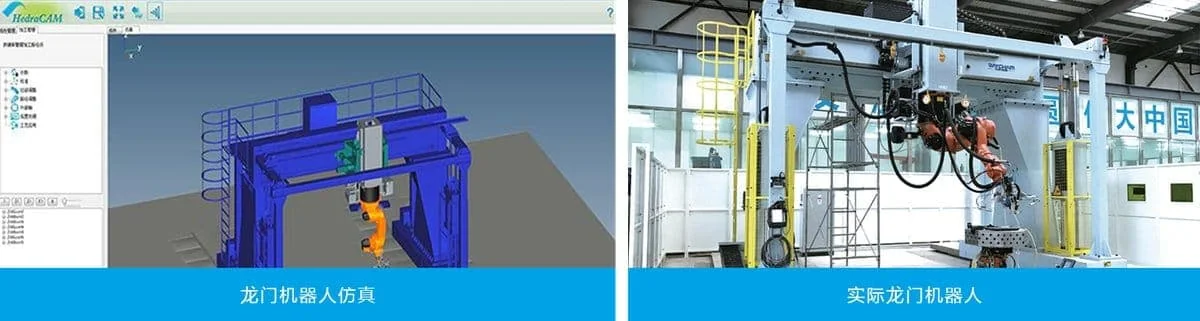
Early industrial robots were mostly unit applications. During offline programming, a simulation module is needed to verify rationality. This simulation environment typically establishes a virtual robot unit identical to the actual one, analyzing the robot's processing trajectory for collisions and jointposture. With the development of PLC and other automation technologies, many factories have connected robot units together using logistics systems. The change in industrial production environments has correspondingly changed software requirements, and various simulation analysis software has emerged.
CAE simulation analysis software in the robotics industry has several main application areas: one is dynamic analysis of mechanical structures in mechanical design; two is production line planning simulation analysis, which is HedraSMF's field; three is analysis of dynamic complex systems, such as terrain scenarios, applied in service robots, transportation and other fields. Our next generation product will also have applications in this area.
In the automated production line planning process, 3D CAD software is typically used for 3D design, then models are transferred to production line simulation software. In the virtual environment, rationality analysis is performed on robots, machine tools, conveyors, personnel and other elements on the production line regarding position, cycle time, robot reachability, collisions, signal control, etc. The generated cycle time data analyzes capacity and forms scientific planning solutions for factory planning designers. In production line simulation analysis software, trajectories generated by CAM offline programming are also commonly used.
From the user perspective, most users of HedraCAM and other offline programming software are frontline industrial robot operators, coming from vocational schools that train frontline technical talent. Enterprise requirements are to maximize programming speed and increase robot effective working hours to improve overall processing efficiency. Software requirements are to be asfoolproof as possible, with ease of use as the principle. Trajectory planning and simulation analysis technology requirements are accurate algorithms and high robot motion trajectory efficiency. In the future, offline programming CAM will gradually transform into intelligent perception-based task automatic programming, where robots collect on-site data through 3D vision technology and automatically adjust and optimize trajectories generated from 3D CAD models.
Users of HedraSMF and similar production line planning simulation software are mostly CAD mechanical design engineers with industrial engineering and automation backgrounds from universities. Their career directions are solution design planning for robotbody companies and integrators, and design departments of large manufacturing enterprises. Software requirements typically include providing large component databases to quickly build production lines, precise motion control algorithms for various robots, various sensor and PLC simulators, scene rendering capabilities, and output of accurate cycle time data and simulation scene animations. In the future, production line simulation technology will develop towards digital twins and real-time dynamics. Digital twins mean that whatever physical characteristics exist in the actual world, the virtual world has the same characteristics. Virtual and actual systems communicate in real-time, and any changes in the actual world dynamically change in the virtual world. Virtual simulation is an essential foundational technology for AI to fullyreplace human production and life.
In summary, offline programming CAM software and production line simulation CAE software are intertwined at the technical level, but have very different application levels and focuses.
Finally, let's discuss the difference between 3D animation and virtual simulation analysis software. In China, many companies create 3D animation solutions for robotics and automation companies. 3D animation is typicallysecondary development using game engines like Unity3D. The biggest difference is that game animation lacks relevant algorithms - no motion control, motion planning, system scheduling, discrete events, geometric graphics, physical modeling and other key technical support. It can neither perform offline programming nor obtain precise cycle time analysis and capacity data. However, 3D animation and virtual simulation analysis software share technologies in rendering, GPU acceleration, and visualization.