Client: Kunshan Jingwei New Material Research Institute Co., Ltd.
Product: HedraCAM Robot OLP
Process: 3D Printing Process Package
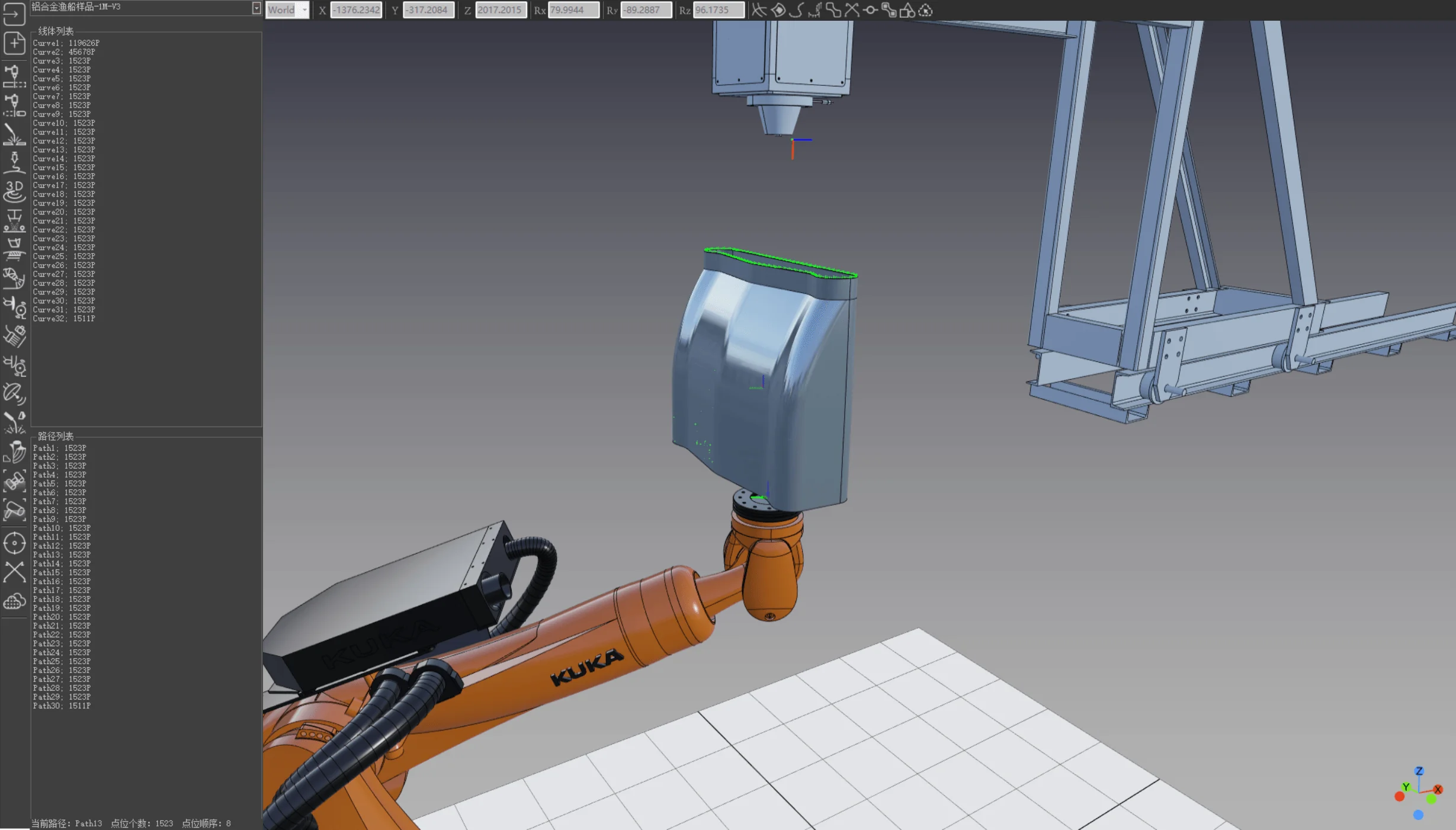
Kunshan Jingwei New Material Research Institute Co., Ltd. has recently equipped its self-developed 3D printing equipment with HedraCAM Robot OLP software, primarily providing offline programming for robotic 3D printing services for specialized aircraft components and large spacecraft structural components.
Key Challenges in Metal 3D Printing:
1. Material ChallengesStringent powder requirements: fine particle size, high sphericity, and good flowability are needed; preparation costs are high, with materials accounting for approximately 30% of total cost (compared to only 3% in traditional processes).Limited material options: currently only a dozen or so materials are supported, including titanium alloys, aluminum alloys, stainless steel, and cobalt-chromium alloys — far fewer than conventional machining.Difficult-to-print materials: copper has low laser absorption rates (requiring green-light SLM breakthroughs), and aluminum alloys have poor weldability.
2. Forming Quality ChallengesThermal deformation and residual stress: the high-temperature melting and cooling process generates thermal stress, causing part warping, distortion, and dimensional deviation.Poor quality consistency: significant performance variations exist between different parts in the same batch and across different machines, making stability difficult to guarantee.Inadequate surface quality: printed parts have rough surfaces, typically requiring extensive post-processing (grinding, heat treatment, machining).Internal defects: porosity, cracking, and lack of fusion are difficult to completely eliminate and affect mechanical properties.
3. Process ChallengesSlow printing speed: efficiency is low compared to traditional manufacturing, resulting in high costs for mass production.Support structure issues: overhanging structures require supports that are difficult to remove and affect surface quality.Multi-laser coordination: in multi-laser systems, laser deflection and mutual interference affect forming quality.
4. Cost ChallengesHigh equipment costs: equipment often costs millions, posing a significant barrier for small and medium enterprises.High post-processing costs: heat treatment, surface treatment, inspection, and other post-processing procedures are complex.Raw material import dependency: domestic high-end metal powder still lags behind international standards.
5. Inspection and Verification ChallengesDifficult in-process quality monitoring: real-time defect detection during printing is challenging; typically only post-production inspection is possible.Complex non-destructive testing: non-destructive testing methods for complex internal cavity structures are not yet mature.
The HedraCAM Robot OLP 3D Printing Process Package minimizes process defects at the software level through precise path planning, point optimization, and post-processor output. Key features include:
1. Flexible Post-Processor Output· Traditional mode: arc/line segment output with acceleration/deceleration at point-type transitions.· Spline group mode: all points treated as a single spline for smoother, more fluid motion.
2. Intelligent Point Generation· Equidistant point generation: resolves speed fluctuations caused by "dense arcs, sparse lines."· Adjustable point spacing: supports adjustment based on robot payload capacity (e.g., 20mm spacing).· Point reduction optimization: addresses robot point capacity limitations.
3. Multi-Program Coordination· Sub-program calls: large projects can be split into multiple small programs (e.g., 50 programs, 20,000 points).· Retraction point insertion: prevents workpiece collisions during program transitions.
4. Robot Brand Adaptation· Supports mainstream industrial robots including KUKA.· Optimized post-processor output tailored to different robot brand characteristics.
5. Field Validation· Real-time debugging and feedback at customer sites.· Collaborative optimization with robot manufacturer technical support teams.
The core value of HedraCAM software lies in providing multiple technical approaches to solve practical process challenges — from point generation to post-processor output, the entire workflow is controllable, helping customers achieve optimal machining results within the constraints of their robot hardware.
About the Client: Kunshan Jingwei New Material Research Institute Co., Ltd. is a global leader in liquid metal 3D printing technology. Founded in 2019 and built upon the School of Materials Science and Engineering at Shanghai Jiao Tong University, the company specializes in R&D and manufacturing of intelligent equipment for melt-impact liquid metal 3D printing, as well as the development and commercialization of novel metal materials. Their products are widely used in high-precision fields including aviation, aerospace, and semiconductors. The core team pioneered melt-impact liquid metal 3D printing technology and equipment, achieving breakthroughs in key core technologies. Their innovations have resolved industrial challenges such as macrosegregation, microstructural uniformity, and rapid prototyping in high-alloy-content large-size ingots of various metal materials, disrupting traditional metal material processing routes and opening new pathways for the design of novel Chinese-grade metal materials.